
20-24 April 2026
K-Stability and Equivariant Birational Geometry
We thank you all for participation!
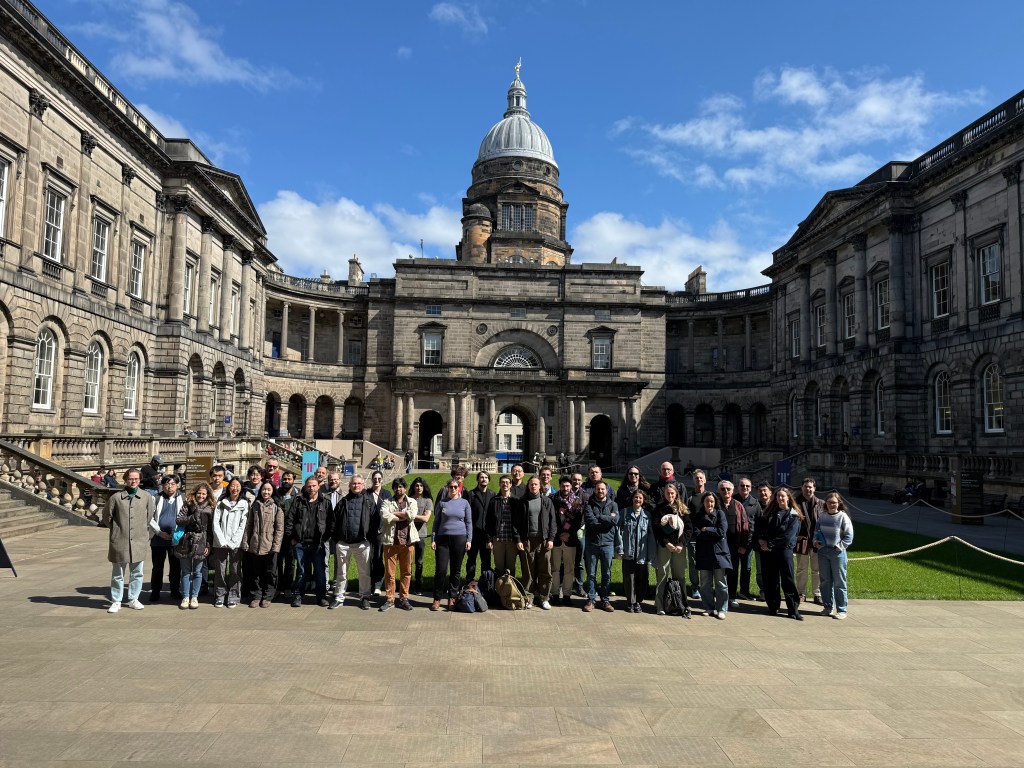
Organisers: Ivan Cheltsov and Robert Śmiech.
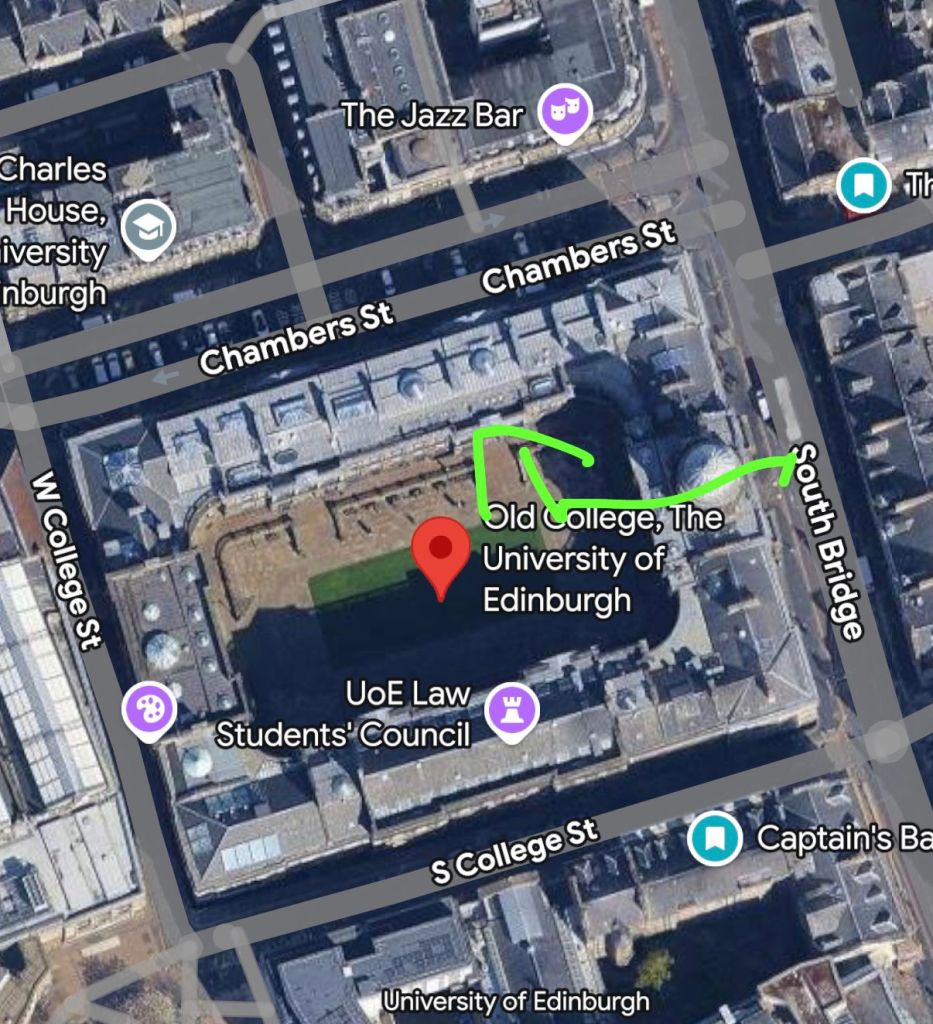
Venue: MacLaren Stuart Room, Old College, University of Edinburgh.
Timetable: See below!
ATTENTION: we would like to warn you against scamming attempts that often target conferences with public speaker/participant list. Do not trust and do not answer to any correspondence that claims to be related to our event that does not come from the official (i.e. associated to the University of Edinburgh) e-mail addresses of the organizers.
Speakers
- Paolo Cascini
- Livia Campo
- Thibaut Delcroix
- Elena Denisova
- Ruadhaí Dervan
- Kristin DeVleming
- Alexander Duncan
- Alexey Elagin
- Andreas Höring
- Dasol Jeong
- Anne-Sophie Kaloghiros
- Ludmil Katzarkov
- Hyunsuk Kim
- Joseph Malbon
- Frédéric Mangolte
- Jesús Martínez-García
- Antoine Pinardin
- Piotr Pokora
- Eleonora Romano
- Luis Solá Conde
- Julia Schneider
- Jarosław Wiśniewski
- Egor Yasinsky
- Susanna Zimmermann
Timetable
| Monday | Tuesday | Wednesday | Thursday | Friday | |
| 10:00-11:00 | DeVleming | Solá Conde | Höring | Cascini | Martinez-Garcia |
| 11:15-12:15 | Dervan | Jeong | Schneider | Duncan | Campo |
| 12:30-13:30 | Kaloghiros | Yasinsky | Zimmermann | Romano | Pinardin |
| 15:30-16:30 | Katzarkov | Wiśniewski | Malbon | Denisova | |
| 16:45-17:45 | Pokora | Delcroix | Elagin | Kim | |
| 18:00-19:00 |
Abstracts
Paolo Cascini
Title: A Matsushima theorem for K-polystable polarised smooth Fano threefolds
Abstract: We prove that if X is a smooth Fano threefold and L is an ample Q-divisor such that (X,L) is K-polystable, then the automorphism group of X is reductive. Joint work with H. Abban and I. Cheltsov.
Livia Campo
Title: K-stability of weighted hypersurfaces
Abstract: In this talk I will discuss K-stability of weighted Fano hypersurfaces of dimension n>=3. The 3-fold case has been established by [Kim-Okada-Won], [Sano-Tasin], [Campo-Okada]. In a joint work with Kento Fujita, Taro Sano, and Luca Tasin we studied the n-fold case with n>3 producing bounds for delta invariants of weighted Fano n-fold hypersurfaces embedded in certain weighted projective spaces.
Thibaut Delcroix
Title: On the effective YTD conjecture
Abstract: This talk will discuss a major open problem which I call the effective YTD conjecture. This is about finding a way to effectively check K-stability for polarized varieties outside of the Fano setting. Even in the equivariant case, say for toric varities, this question seems very hard to address. The best partial result in this direction is in Donaldson’s work on K-stability of toric surfaces, and I will also review my own work on spherical varieties.
Elena Denisova
Title: K-moduli of Fano threefolds of Picard rank 3 and degree 20.
Abstract:
(Joint work in progress with T. Papazachariou)
K-moduli spaces provide a canonical parametrization of K-polystable Fano varieties, but they are rarely accessible in concrete terms. In this talk I will describe an explicit example in dimension three. I will consider the Fano threefolds in Mori-Mukai family №3.5, which can be realised as blow-ups of P1xP2 along curves of bidegree (5,2). I will explain how the K-stability of these threefolds is determined by the classical GIT stability of the corresponding curves. This leads to an explicit description of the K-moduli space as a GIT quotient and yields a K-classification of all members of the family.
Ruadhaí Dervan
Title: K-stability for big classes
Abstract: K-stability is usually defined for projective varieties endowed with ample line bundles. I will explain why one might be interested in defining a notion of K-stability for projective varieties endowed instead with big line bundles, and how to do so. I will give an explicit valuative criterion, and will also discuss some results about how this notion of K-stability behaves birationally. This is joint work with Rémi Reboulet.
Kristin DeVleming
Title: Weighted projective degenerations of projective space
Abstract: We will discuss the problem of classifying weighted projective spaces that admit a smoothing to P^n, and derive two infinite families of examples and two sporadic examples in every dimension at least 4. Along the way, we will discuss deformations of weighted projective threefolds in general.
Time permitting, we will discuss several applications, to K-stability of log Fano pairs, smooth limits of families of complete intersections, and non-canonical curves of genus g.
Alexander Duncan
Title: Amitsur Subgroups in Arithmetic and Equivariant Geometry
Abstract: For a variety defined over a field, a line bundle over the algebraic closure may fail to descend to a line bundle on the original variety. Similarly, if there is a group action, that action may fail to lift to certain line bundles. The Amitsur subgroup precisely measures this failure, taking values in the Brauer group of the field (or in an equivariant analog). A key property of the Amitsur subgroup is that it is an (equivariant) birational invariant. When all overfields and subgroups are considered, it is fine enough to completely distinguish between varieties in several interesting classes. I will discuss how the language of Mackey functors can be used to describe and compute the Amitsur subgroup, especially in the cases of Fano varieties, toric varieties, and torsors of tori.
Alexey Elagin
Title: Categorical atoms and birational classification of surfaces
Abstract: In a recent work with Julia Schneider and Evgeny Shinder we constructed canonical “atomic” semi-orthogonal decompositions for derived categories of surfaces. Components of these decompositions are called atoms and provide birational invariants of surfaces. I will explain how to compare atoms and compute some examples. Then I will review birational classification of surfaces over an arbitrary perfect field in terms of atoms, which appears to be uniform and concise. These results are known in most cases due to a number of works by many people, but some are new: for example, we show that two birational minimal del Pezzo surfaces of degree 4 are isomorphic.
Andreas Höring
Title: Intersection of two quadrics: modular interpretation and Hitchin morphism
Abstract: Let X be a smooth complete intersection of two quadrics in a projective space. The manifold X does not have any non-zero vector fields, but in earlier work with Beauville, Etesse, Liu and Voisin we showed that the symmetric tensors of the tangent bundle define a Lagrangian fibration on the total space of the cotangent bundle. By a result of Ramanan the complete intersection also has a modular interpretation, i.e. is isomorphic to a moduli space of “Spin bundles”. This allows to define a Hitchin morphism on the total space of the cotangent bundle. I will present all these constructions and show that the two fibrations coincide. This is joint work with Vladimiro Benedetti and Jie Liu.
Dasol Jeong
Title: Conical Kähler-Einstein metrics on K-unstable del Pezzo surfaces
Abstract: For a Fano manifold X, the greatest Ricci lower bound R(X), arising from the continuity method, plays a key role for the study of Kähler-Einstein metrics. In particular, the existence of Kähler-Einstein metric implies that R(X)=1.
On the other hand, Yau-Tian-Donaldson conjecture was solved using Kähler-Einstein metric with singularities along (pluri)anticanonical divisor D. Motivated by the formal similarity between the equations arising in the continuity method and those defining conical Kähler–Einstein metrics, Donaldson conjectured that R(X) coincides with the supremum R(X,D) of cone angles along anticanonical divisors D on X.
However, Székelyhidi provided counterexamples in the surface cases. Note that there are only two K-unstable smooth del Pezzo surfaces S_1 and S_2, that are blowups of P^2 at one point and two points, respectively.
In this talk, I will briefly review the history and introduce several tools such as K-stability and delta invariants. Then, I will explain how to find R(S_i,C_i) for i=1,2 using delta invariant, where C_i are smooth anticanonical curves on S_i.
Anne-Sophie Kaloghiros
Title: On K-moduli of prime Fano threefolds of genus 12
Abstract: Over the past decade, much progress has been made in understanding explicit K-stability of smooth Fano threefolds. We now know which of the 105 deformation families of smooth Fano 3-folds correspond to a non-empty K-moduli space, and have a complete description of these K-moduli spaces in many cases. Current techniques however do not tell us much about K-moduli spaces of prime Fano threefolds. An especially interesting case is that of prime Fano threefolds of genus 12 (V22). While the general Fano of type V22 is K-stable, some strictly K-semistable examples are known. In this talk, I will describe the boundary of the K-moduli stack of Fano threefolds of type V22.
Ludmil Katzarkov
Title: New birational invariants
Hyunsuk Kim
Title: Hodge theory of toric singularities
Abstract: I will start with spending some time on why one might care about Hodge theoretic properties of a singularity using Du Bois complexes, especially in the viewpoint of period maps defined on moduli spaces of varieties.
The Hodge theoretic behavior of singularities has been well-understood in the local complete intersection case by various works, while the general picture yet is not so clear. I will discuss a joint work with Sridhar Venkatesh on a detailed description of toric singularities in the Hodge theoretic point of view, which provides a fruitful class of examples beyond lci singularities.
Jesus Martinez-Garcia
Title: K-moduli spaces of del Pezzo log pairs.
Abstract: K-polystable Fano varieties are known to form a projective moduli space in any dimension and there is an analogue result for log Fano pairs. However, how each connected or irreducible component of the moduli space looks like and what is included is less clear, not the least because Fano varieties are only classified in low dimensions and with prescribed singularities. Moreover, even for smooth Fanos, the boundary of the K-moduli component will contain singular elements (sometimes very singular ones). There is a booming industry aiming to describe the different components of the K-moduli space in low dimensions, in particular in threefolds. The case of log pairs is, on the one hand less tractable (due to the multiple possibilities of boundaries, even for components parameterising log smooth pairs) and on the other hand more interesting, for it allows us to consider stability conditions which, when perturbed, result in birational transformations in the K-moduli. In such setting, we have a wall-chamber structure on the space of stability conditions and different K-moduli compactifications for each stability condition. For any given example, the most immediate natural questions include:
Q1) Describe the wall-chamber decomposition of the space of stability conditions.
Q2) Describe the elements represented in the K-moduli for each stability condition
Q3) Describe the K-moduli itself as a projective variety.
In this talk, we will briefly introduce these notions under the paradigm of asymptotically log Fano (ALF) varieties, introduced by Cheltsov and Rubinstein. Then, we will focus on the case of ALF surfaces of types (I.1.A), (I.4A) and (I.5.m), 1 ≤m ≤7, consisting of a log pair (X,D) where X is a del Pezzo surface of degree at least 2 and D is an anti-canonical divisor. I will explain how we answered Q1 and Q2 for these cases (including determining the invariant R of a pair, as introduced by Donaldson). We also explain how we can give partial answers to Q3 using Geometric Invariant Theory. Time permitting, I will give a brief overview on how this problem could be considered on other ALF surfaces with few modifications, using the classification by Cascini, Rubinstein and myself as well as some problems that can be considered over our existing classification. This is joint work with Theodoros Papazachariou and Junyan Zhao, and it builds on previous joint work with Gallardo and Spotti and in Papazachariou’s thesis.
Antoine Pinardin
Title : Finite simple subgroups of the real Cremona group of rank three.
Abstract : In a joint work with Ivan Cheltsov and Yuri Prokhorov, we prove that the only non cyclic finite subgroups of Cr(3,R) are A5 and A6.
Piotr Pokora
Title: Geometry of lines on smooth quartic surfaces
Abstract: We study the geometry of arrangements of rational curves on smooth quartic surfaces over the complex numbers, using methods from logarithmic geometry. In particular, we investigate pairs of the form (smooth quartic surface, arrangement of lines) and analyze their Chern slopes. Our results show that the highest Chern slope currently known for such pairs is achieved by the Fermat quartic surface.
Eleonora Romano
Title: K-polystability of Fano 4-folds with large Lefschetz defect
Abstract: We investigate the K-polystability of smooth complex Fano 4-folds with Lefschetz defect at least 2, with particular emphasis on the cases of Lefschetz defect 3 and on Casagrande–Druel Fano 4-folds with Lefschetz defect 2. After recalling the classification of Fano 4-folds with Lefschetz defect 3, we show that exactly five of the corresponding deformation families are K-polystable. We then discuss K-polystability within the class of Casagrande–Druel Fano 4-folds with Lefschetz defect 2, where K-polystability occurs only in very few cases. The results presented in this talk are joint work with S. A. Secci.
Luis Solá Conde
Title: Chow quotients of flag varieties
Abstract: In this talk I will present a construction of the Chow quotient of the complete flag variety of C^4 by the action of a maximal torus in its automorphism group, and its birational properties. We will also discuss how to extend this construction to other rational homogeneous spaces.
Julia Schneider
Title: Atomic semi-orthogonal decompositions for derived categories of G-surfaces.
Abstract: In this talk, I discuss a joint work with Alexey Elagin and Evgeny Shinder that lies at the intersection of birational and derived geometry. What kind of geometric information is encoded in the derived category of a variety, and how does this information behave under birational maps? We consider the case of surfaces equipped with a group action, and show that their derived categories admit a canonical (mutation-equivalence class of) semi-orthogonaldecompositionthat “behaves well” with respect to birational geometry. We call such decompositions “atomic”. If time permits, I will discuss applications to (bi-)rationality questions.
Jarosław Wiśniewski
Title: Graphs with translations and compasses, upgrading torus action.
Abstract: Given an algebraic torus action on a smooth projective variety
with a finite number of fixed points and 1-dimensional orbits we describe
it in terms of a GKM graph (GKM=Goresky-Kottwitz-MacPherson) with extra
features. There are natural questions about recovering the geometry of the
variety in question from the graph of the torus action. For example: is
the variety toric and the torus action is a downgrading of the big torus
action? I will report on the joint work with Maria Donten-Bury.
Egor Yasinsky
Title: The pliability of del Pezzo surfaces
Abstract: I’ll discuss what is known about birational maps from minimal del Pezzo surfaces over non-closed fields to other Mori fibre spaces.
Susanna Zimmermann
Title: Automorphism groups of Mori Del Pezzo fibrations
Abstract: In series of five articles, Umemura classified connected automorphism groups of rational threefolds up to conjugation by birational maps and up to inclusion. The classification was recovered with methods from the Minimal Model Program by Blanc-Fanelli-Terpereau.
In this talk, I want to address the question for threefolds birational to a Mori fibre space above a curve of genus at least one whose generic fibre is a Del Pezzo surface.
 Simons Collaborations on Moduli of Varieties